
Step 1 of 9
What we rate
What we rate
Read the full text
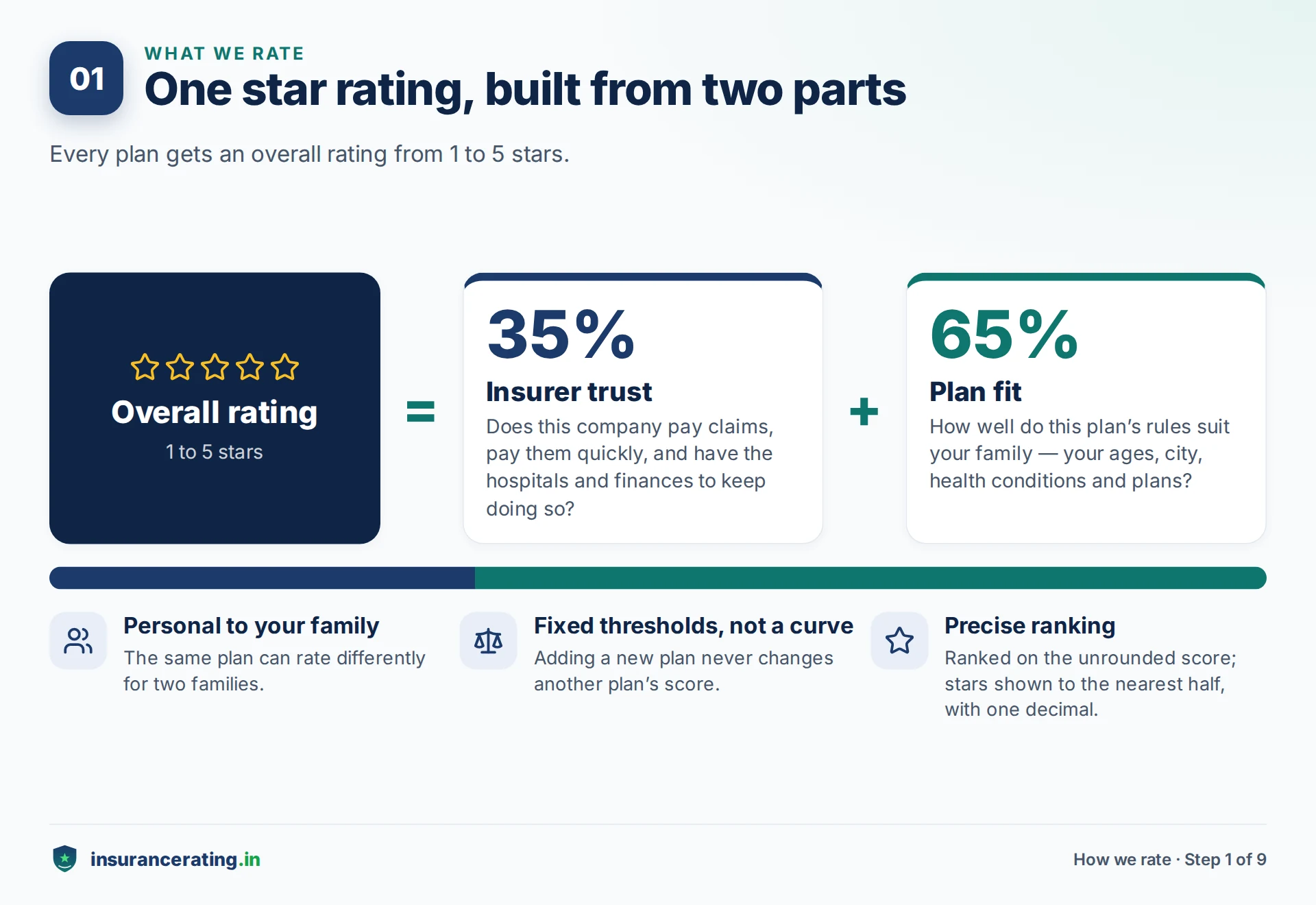
Every plan gets an overall rating from 1 to 5 stars, built from two parts:
- Insurer trust — 35%. Does this company pay claims, pay them quickly, and have the hospitals and finances to keep doing so?
- Plan fit — 65%. How well do this plan’s rules suit your family — your ages, city, health conditions and plans?
The same plan can rate differently for two families. Thresholds are fixed numbers, not a curve: adding a new plan never changes another plan’s score. Plans are ranked on the unrounded score; stars are shown to the nearest half with one decimal.
Insurer trust: what we look at
Read the full text
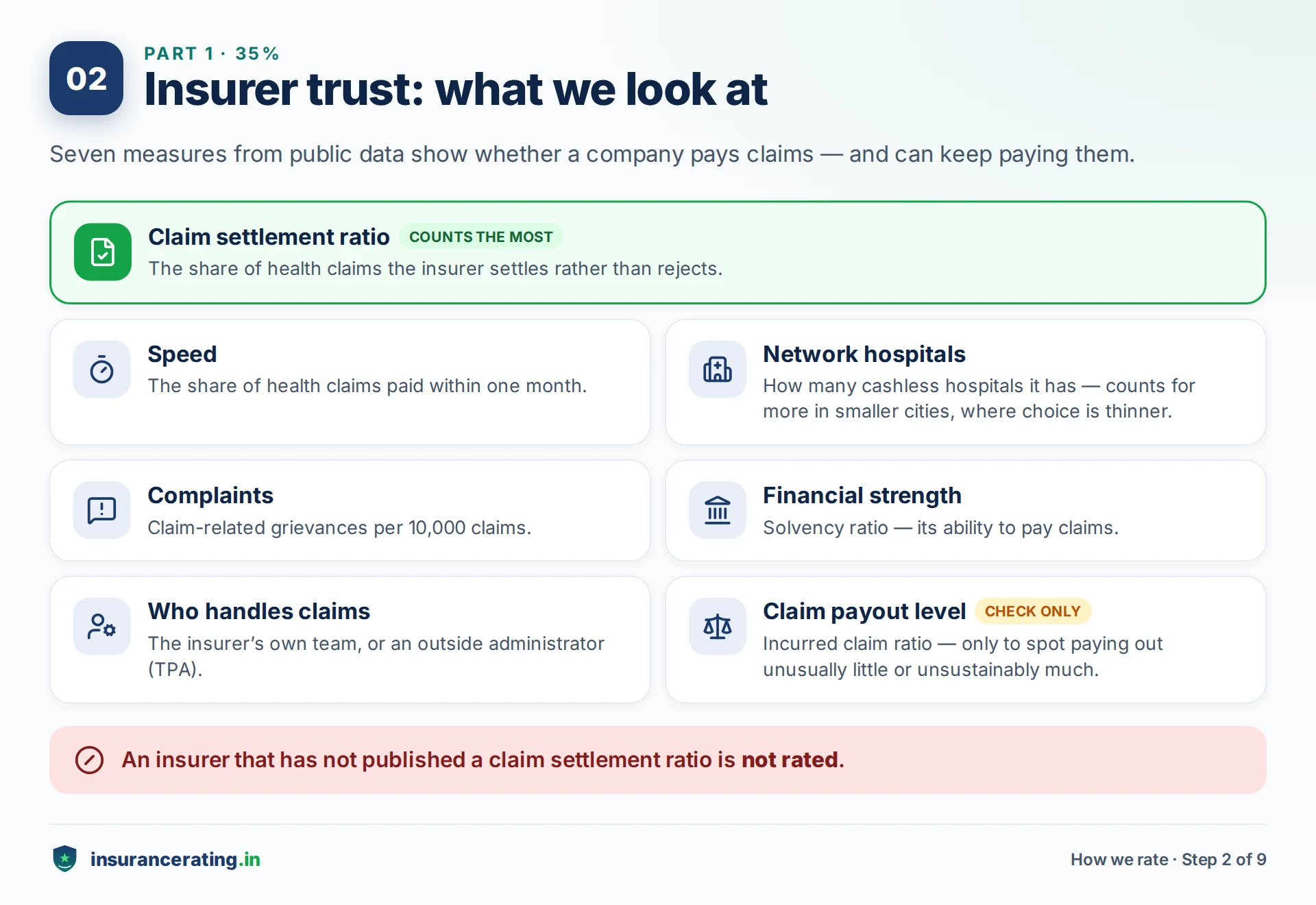
- Claim settlement ratio — the share of health claims the insurer settles rather than rejects. This counts the most.
- Speed — the share of health claims paid within one month.
- Network hospitals — how many cashless hospitals the insurer has. This counts for more if you live in a smaller city, where choice is thinner.
- Complaints — claim-related grievances per 10,000 claims.
- Financial strength — the insurer’s solvency ratio, a measure of its ability to pay claims.
- Who handles claims — the insurer’s own team, or an outside administrator (TPA).
- Claim payout level — the incurred claim ratio, used only to spot an insurer paying out unusually little or unsustainably much.
An insurer that has not published a claim settlement ratio is not rated.
Plan fit: what we look at
Read the full text
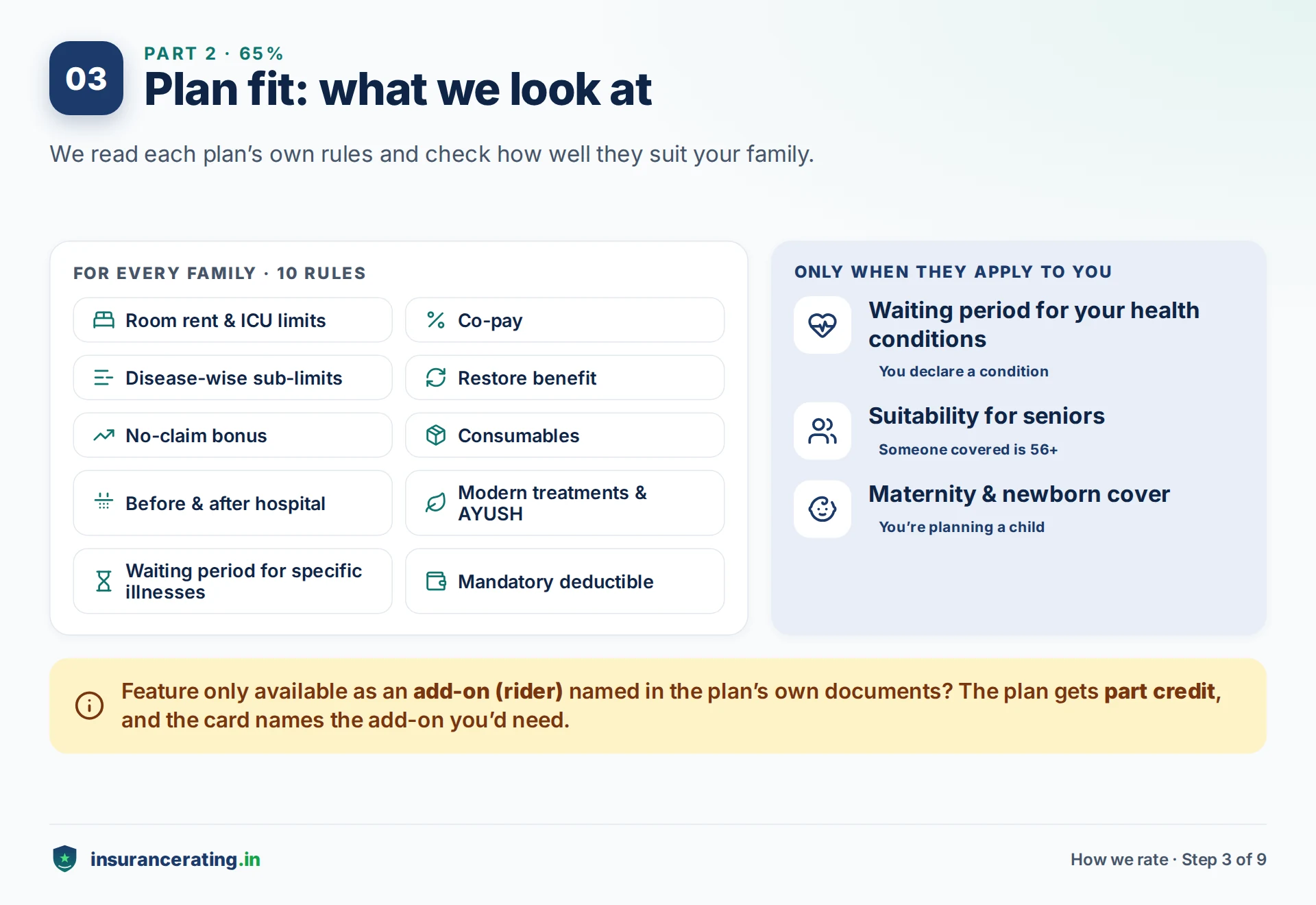
For every family:
- Room rent and ICU limits — whether the plan caps the room you can stay in.
- Co-pay — a share of every claim you must pay yourself.
- Disease-wise sub-limits — caps on what the plan pays for named treatments.
- Restore benefit — whether your cover refills after a claim.
- No-claim bonus — how much your cover grows in years without claims.
- Consumables — gloves, PPE and similar items many plans do not pay for.
- Before and after hospital — how many days of costs around a stay are covered.
- Modern treatments and AYUSH — whether these are covered in full.
- Waiting period for specific illnesses — e.g. cataract, hernia, joint replacement.
- Mandatory deductible — an amount you must pay before the plan pays anything.
Only when they apply to you:
- Waiting period for your declared health conditions — only if you tell us about a condition.
- Suitability for seniors — only if someone covered is 56 or older.
- Maternity and newborn cover — only if you are planning a child.
Where a feature is only available as an add-on (rider) named in the plan’s own documents, the plan gets part credit and the card says which add-on you would need.
Where the data comes from
Read the full text
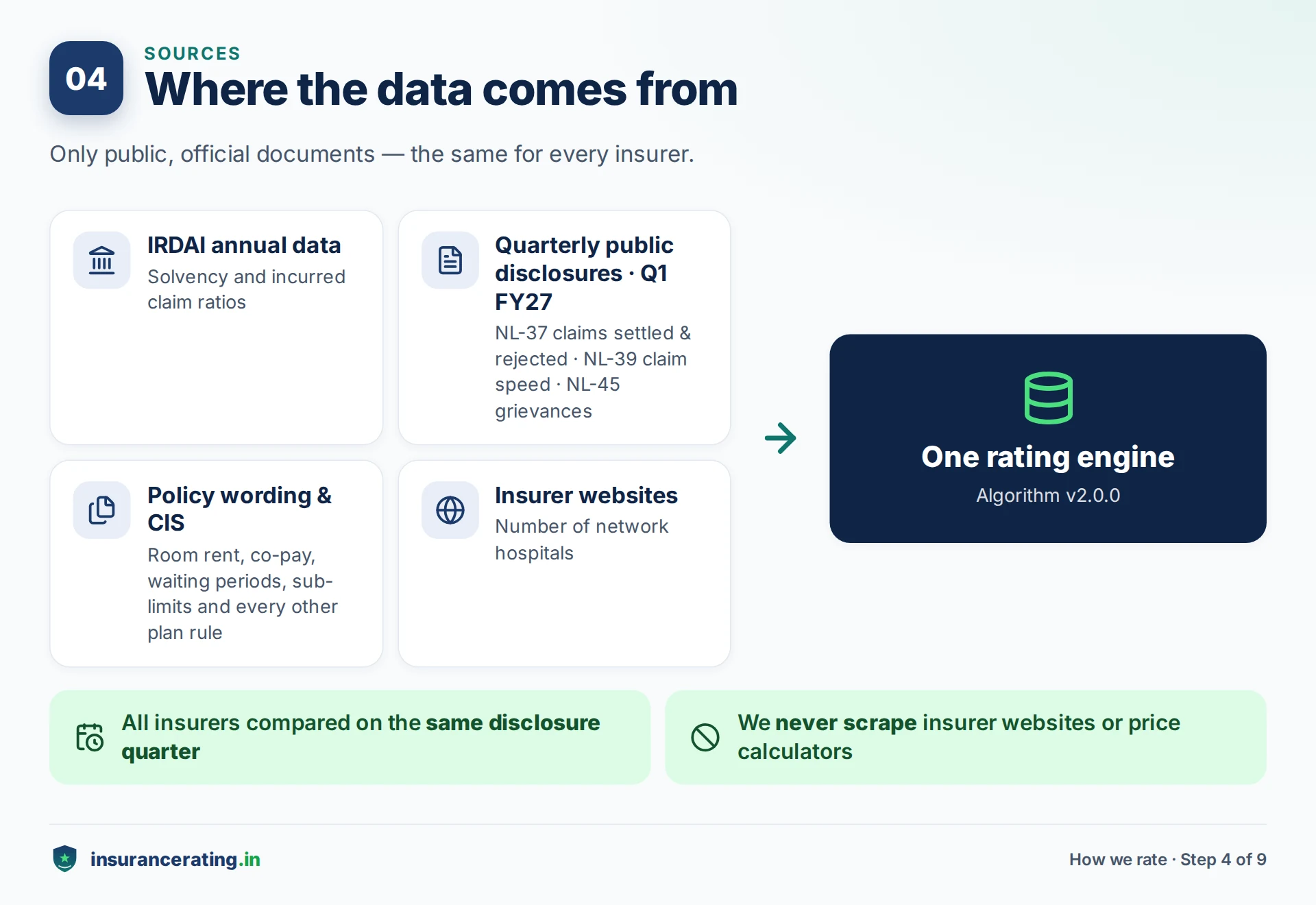
- IRDAI annual data — solvency and incurred claim ratios.
- Insurers’ quarterly public disclosures for Q1 FY27: form NL-37 (claims settled and rejected), NL-39 (how quickly claims are paid) and NL-45 (grievances).
- Each plan’s policy wording and Customer Information Sheet (CIS) — room rent, co-pay, waiting periods, sub-limits and every other plan rule.
- Insurer websites — number of network hospitals.
All insurers are compared on the same disclosure quarter. We never scrape insurer websites or price calculators.
How your answers change the rating
Read the full text
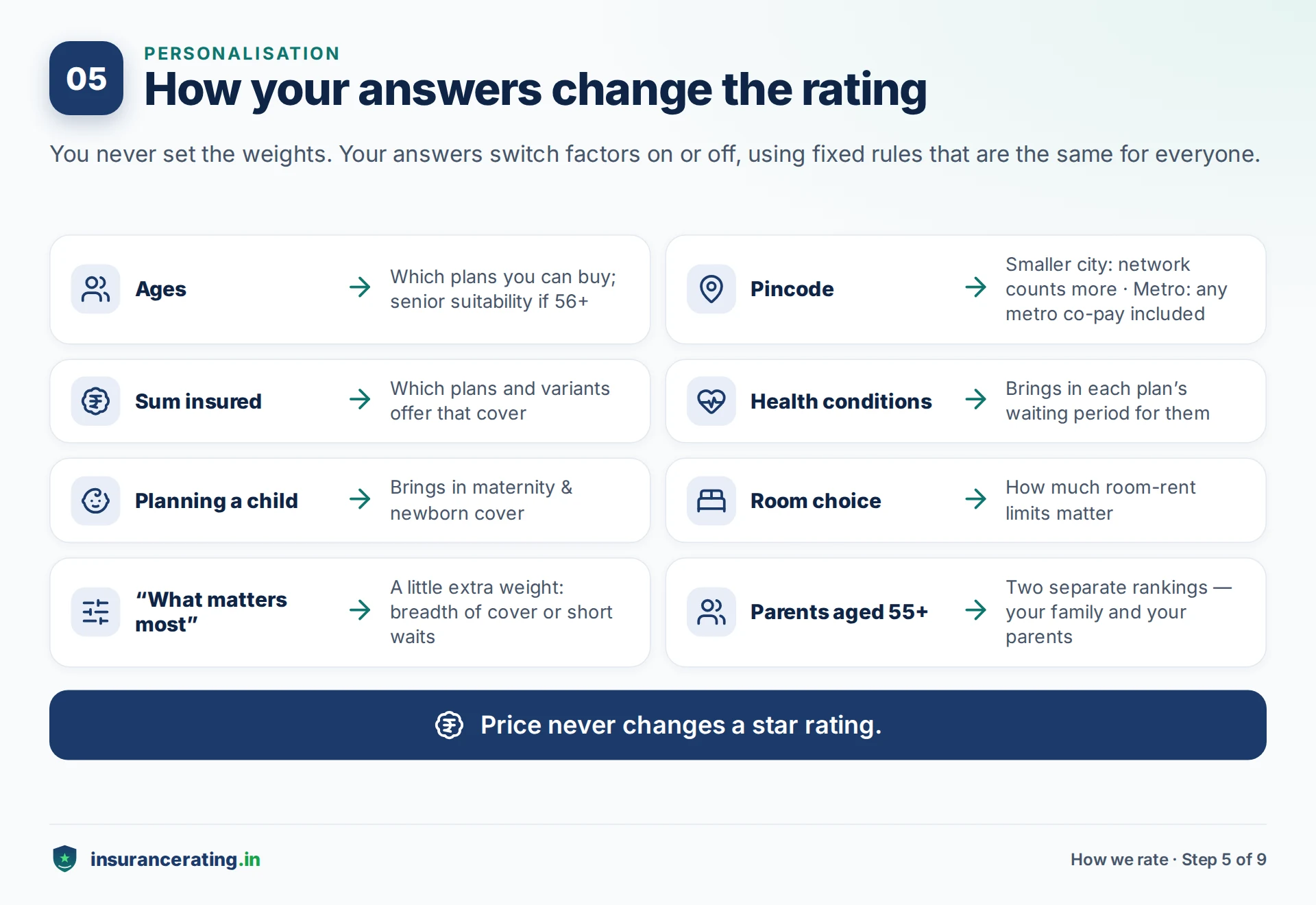
You never set the weights yourself. Your answers switch factors on or off and adjust how much some of them count, using fixed rules that are the same for everyone:
- Ages decide which plans you can buy at all, and switch on senior suitability when someone is 56 or older.
- Your pincode tells us whether you live in a large metro or a smaller city. In smaller cities the hospital network counts for more; in large metros, any extra co-pay a plan charges for metro treatment is included.
- Sum insured decides which plans and variants offer that cover.
- Health conditions bring in each plan’s waiting period for those conditions.
- Planning a child brings in maternity and newborn cover.
- Your room choice changes how much room-rent limits matter to your rating.
- “What matters most” gives a little extra weight to either breadth of cover or short waiting periods.
- If you cover parents aged 55 or more, you get two separate rankings — one for your family, one for your parents — because separate policies usually work out better.
Price never changes a star rating.
Red flags and caps
Read the full text
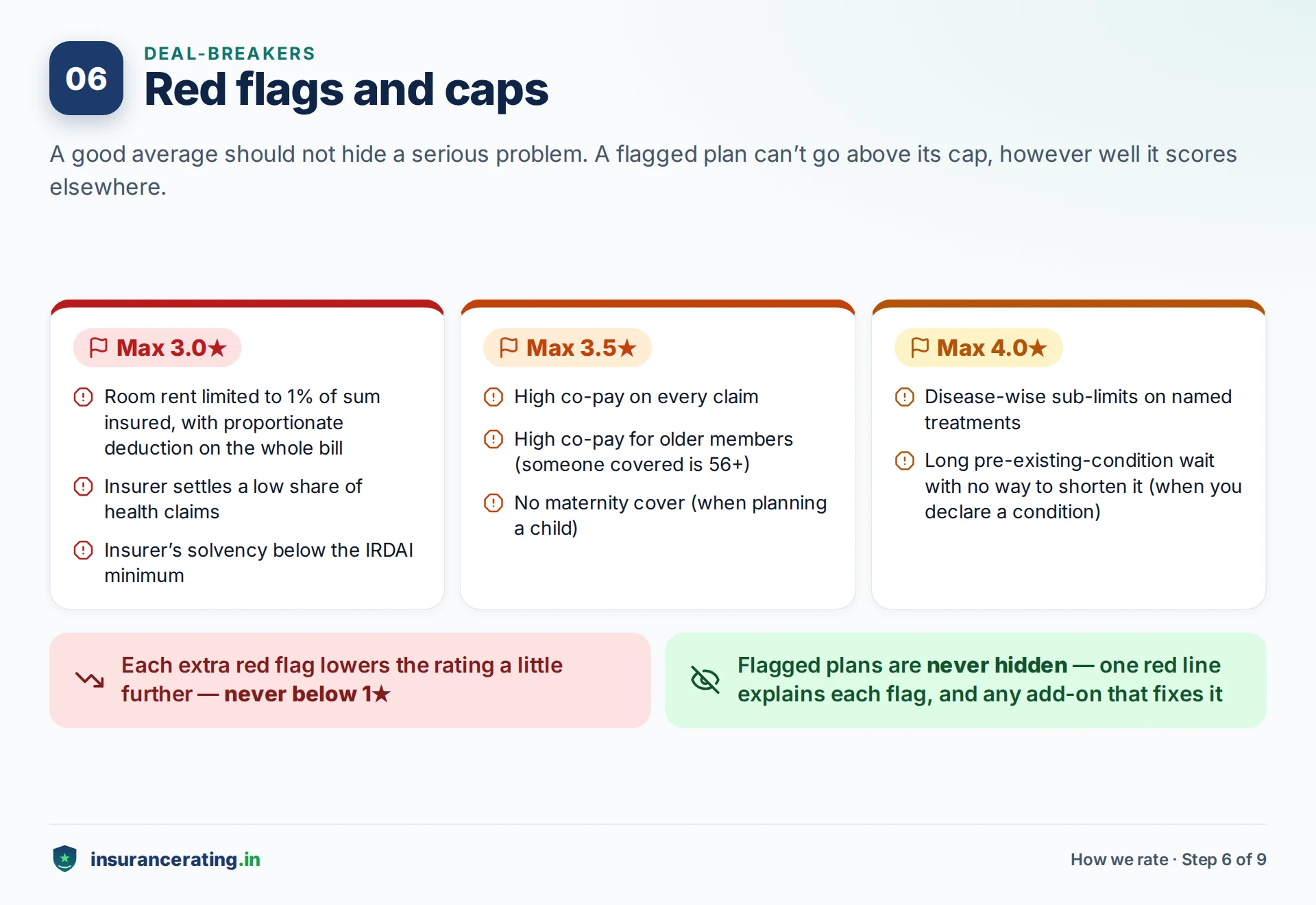
Some problems are deal-breakers that a good average should not hide. If a plan has one of these, its overall rating cannot go above the cap shown, however well it scores elsewhere:
- Room rent limited to 1% of the sum insured, with proportionate deduction on the whole bill — at most 3.0★
- A high co-pay on every claim — at most 3.5★
- A high co-pay on every claim for older members (when someone covered is 56 or older) — at most 3.5★
- Disease-wise sub-limits on named treatments — at most 4.0★
- The insurer settles a low share of health claims — at most 3.0★
- The insurer’s solvency is below the IRDAI minimum — at most 3.0★
- No maternity cover (when you are planning a child) — at most 3.5★
- A long wait for pre-existing conditions with no way to shorten it (when you declare a condition) — at most 4.0★
Each extra red flag lowers the rating a little further, never below 1 star. Flagged plans are always shown — never hidden — with one red line explaining each flag and, where an add-on fixes it, what the fix is.
Plans we can’t rate
Read the full text
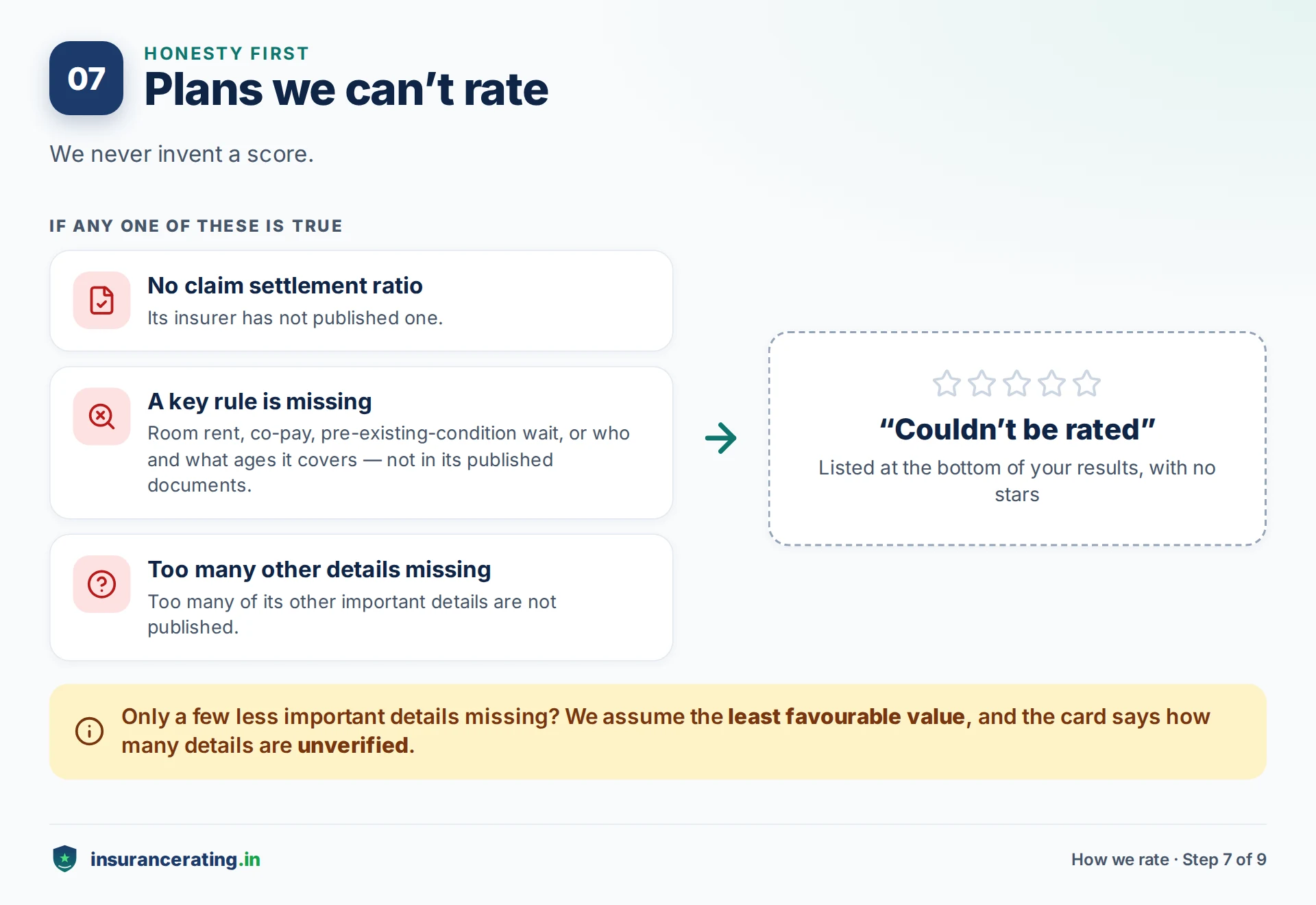
We never invent a score. A plan is listed under “couldn’t be rated” at the bottom of your results, with no stars, when:
- its insurer has not published a claim settlement ratio;
- a key rule — room rent, co-pay, the pre-existing-condition wait, or who and what ages it covers — is not in its published documents; or
- too many of its other important details are missing.
If only a few less important details are missing, we assume the least favourable value and the card says how many details are unverified. Plans without published policy details cannot be rated fairly.
How often the data is updated
Read the full text
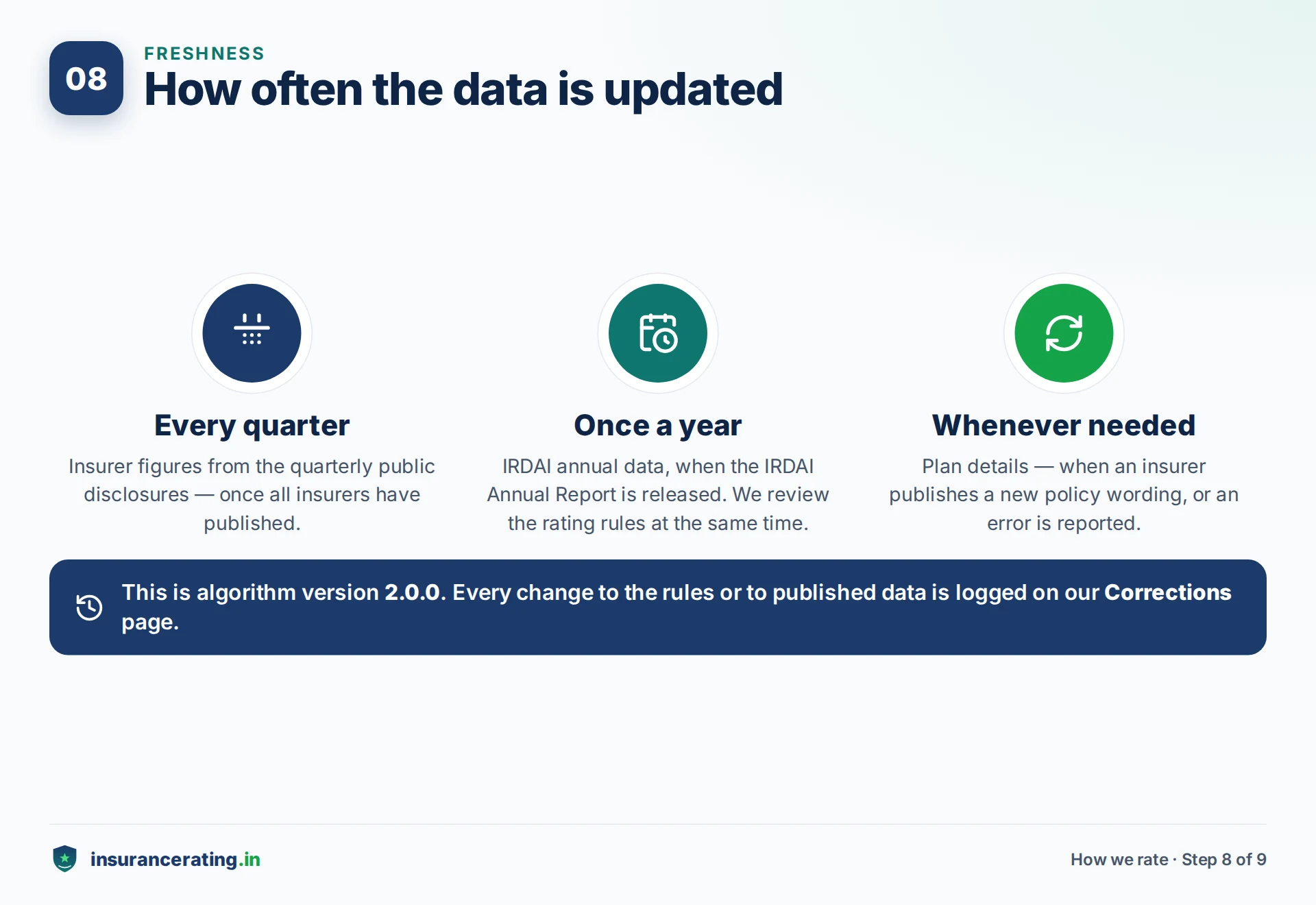
- Insurer figures from the quarterly public disclosures — every quarter, once all insurers have published.
- IRDAI annual data — once a year, when the IRDAI Annual Report is released. We review the rating rules at the same time.
- Plan details — whenever an insurer publishes a new policy wording, and whenever an error is reported.
This is algorithm version 2.0.0. Every change to the rules or to published data is logged on our Corrections page.
How we make money
Read the full text
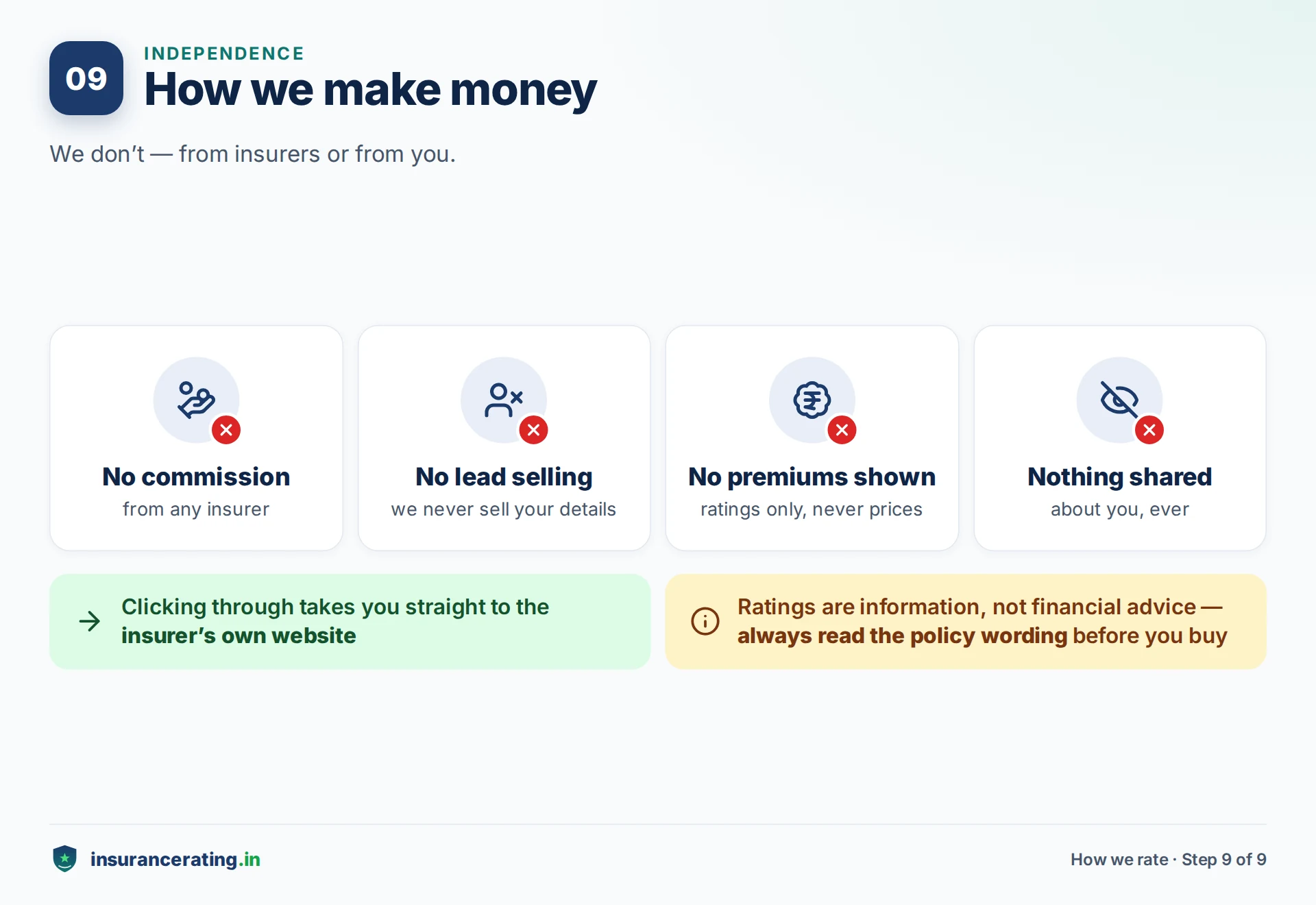
We earn no commission from any insurer, we do not sell leads, and we do not show premiums. Clicking through to an insurer takes you to its own website; we share nothing about you. Ratings are information, not financial advice — always read the policy wording before you buy.